Hassan Nawaz
PhD Student in Chemical & Biomolecular Engineering, Hong Kong University of Science and Technology — advised by Prof. Hanyu Gao
M.Sc. Physical Chemistry, Xiamen University — advised by Prof. Pavlo O. Dral
Applying machine learning and data science to problems in chemical and materials engineering.
Publication metrics synced from Google Scholar · last checked September 2026
Machine Learning & AI for Chemical and Material Sciences
I'm a PhD student at the Hong Kong University of Science and Technology (HKUST), advised by Prof. Hanyu Gao, and was previously advised by Prof. Pavlo O. Dral during my Master's at Xiamen University. I'm broadly interested in applying machine learning and data science techniques to solve problems in chemical and materials engineering.
That interest spans accelerating molecular simulations, building AI agents that support computational chemistry research, and developing models that compress the loop between a research question and a validated molecular or material design.
Focus areas
Machine learning across chemistry and materials
A quick look at the threads running through my work — see the Research page for the full picture, straight from my CV.
Machine Learning for Chemistry & Materials
Applying data-driven and machine learning methods to problems across chemical and materials engineering, from molecular simulation to materials design.
Machine Learning Potentials
Developing MLIPs aimed at surpassing standard DFT accuracy — descriptor engineering, training, and rigorous benchmarking.
AI Agents for Science
Fine-tuned domain LLMs (LoRA), RAG knowledge systems, and multi-agent workflows (LangGraph) for autonomous computational chemistry.
Thermochemistry & Benchmarking
Ensemble learning across models trained on the ANI dataset, and improved thermochemical predictions incorporating vibrational anharmonicity.
Aitomia
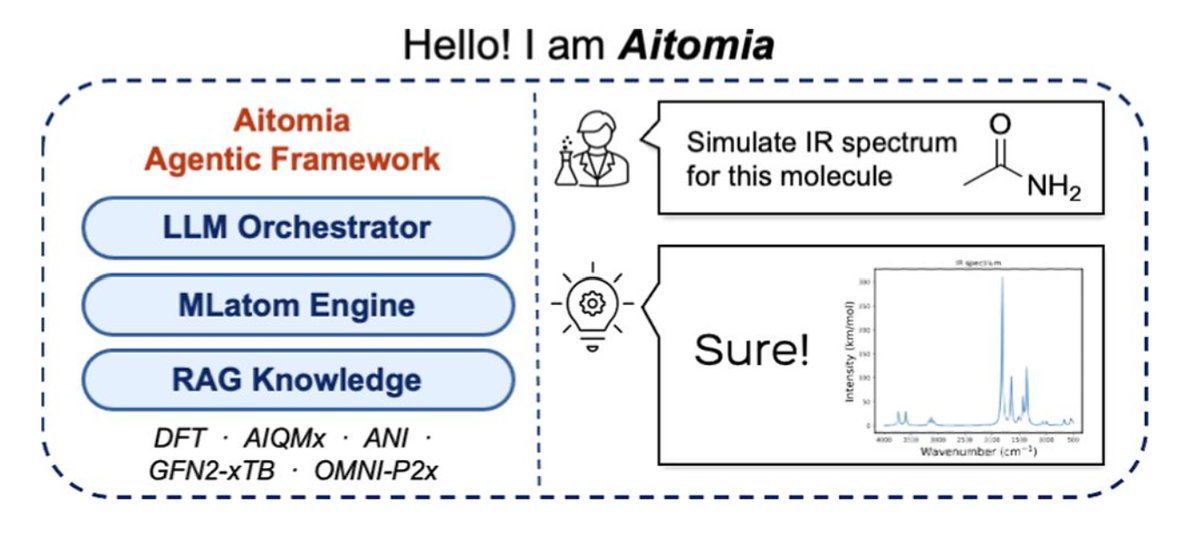
An agentic, AI-driven platform integrating large language models, scientific workflows, and machine learning tools (MLatom, AIQM) to streamline computational chemistry — from input generation to result interpretation. Published in Journal of Chemical Theory and Computation, 2026.
Hu, J.; Nawaz, H.; Hou, Y. F.; et al. — Hu, Nawaz, and Hou contributed equally as co-first authors.